
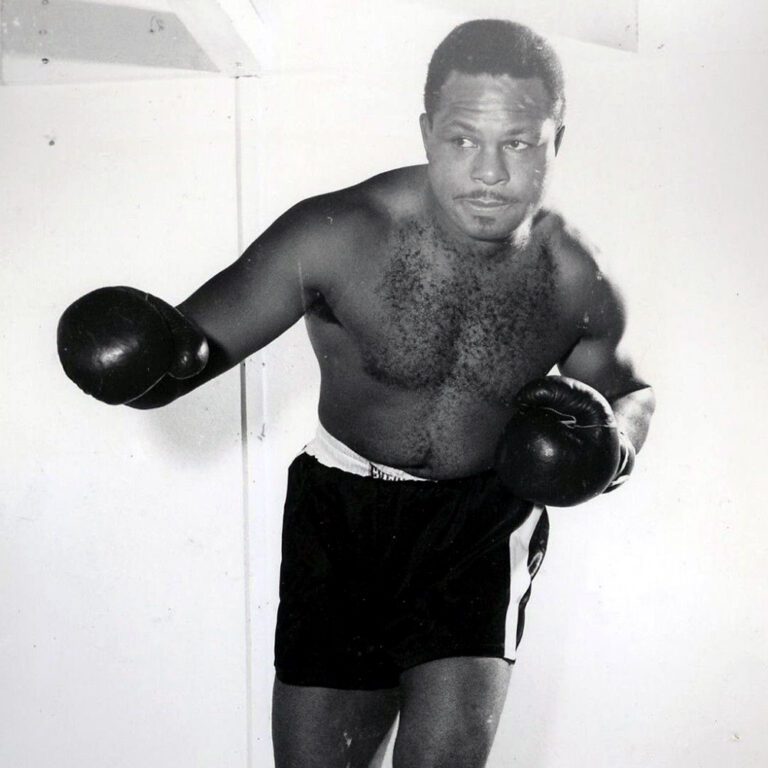
A few days ago, idle at home and turning things over in my head in search of a story that might be interesting for this very page, the name Archibald Lee Wright suddenly sprang to mind. He struck us as a fine character for readers to spend some time with—learning a bit about his journey through the squared circle, where he left an indelible mark as one of the 10 or 20 greatest boxers of all time, beyond any debate.
We imagine that by now readers must be wondering—intrigued, and with good reason—“Who is, or was, this Archibald Lee Wright?” To clear up the question raised in the opening lines, let’s just say it plainly: that name belongs to the man boxing in particular—and the sporting world at large—came to know and admire as Archie Moore, a name given to him by Cleveland and Willie Pearl Moore, the uncle and aunt who raised him from a very young age after his mother left him in their care, having been abandoned by her husband just a few months after Archie was born—reportedly on December 13, 1913 or 1916, in Benoit, Mississippi.
As time went on, Archie Moore would be regarded as a ring immortal—to put it simply, the greatest light heavyweight (175 pounds or 79.378 kilograms) from the end of the 19th century to the present day. He is widely viewed as the all-time best in that weight class across boxing’s long and storied history of fists, gloves, and ropes.
Still a teenager, the restless and mischievous Archibald ran into behavioral trouble that landed him in a reformatory, where he would remain for two years before emerging to pursue boxing. After a relatively brief stint as an amateur, he turned pro at age 19 (or 21—no one knows for sure. Many key facts of his life remain a mystery), making his debut on 11/3/1935 with a knockout win over Billy Simms. He quickly added eight more victories, along with a couple of draws, before suffering his first loss to Billy Adams two years later in September 1937.
He soon got back on track, continuing to cover the canvas with victims for nearly three decades, amassing 141 knockouts—an unmatched and seemingly unreachable number (unofficial stats—some sources credit him with 10 fewer KOs). That staggering total came during a long career in which he was known for a tight, crafty defense in the cross-armed guard (the so-called “crab” style), constant upper-body movement, sudden and powerful flurries, and fierce counterpunches—often delivered with the kind of pop that turned lights out.
By the time he left the ring, he had compiled 194 fights with 26 losses, 7 by KO, and 8 draws. That’s according to The Boxing Record Book (1998). Meanwhile, BoxRec credits “His KO Majesty” with 186 wins (132 KOs), 27 losses (7 KOs), and 10 draws. Other sources list 219 bouts, 185 wins (131 by KO), 23 losses (7 by KO), and 10 draws—figures largely accepted as official. In total knockouts, Moore is trailed by Young Stribling (129), Sam Langford (128), Mexico’s Kid Azteca (114)—the only Latino on the list—and Sugar Ray Robinson (109).
A LONG WAIT FOR A CROWN
Due to the dark color of his skin, and in an era (as well as today) marked by vicious racial discrimination in the United States, Moore—despite his incredible record and obvious talent—had to wait a full 17 years for a world title shot. For the same reason, he had earlier been forced to leave the U.S. and fight in Argentina and Uruguay in 1951, where he racked up 8 wins, 6 by knockout.
He returned to South America in 1953, now as world champion, and added two more wins. In those Latin American lands—especially Argentina—he was widely admired, so much so that then-president Juan Domingo Perón and his wife, Evita, befriended and idolized him.
His first crack at a world title came on July 12, 1952, at the age of 34 (if born in 1916) or 39 (if born in 1913)—two dates never officially confirmed. On that distant July 12th, 1952, Moore defeated reigning light heavyweight champion Joey Maxim (Giuseppe Antonio Berardinelli) over 15 rounds. He would go on to defend the crown 10 times—against Maxim again (twice, both 15-round decisions), Carl “Bobo” Olson (KO 3), Harold Johnson (TKO 14), Yolande Pompey (TKO 10), Tony Anthony (UD 7), France’s Yvon Durelle (twice, TKO 11 and TKO 3), and Italy’s Giulio Rinaldi (UD 15)—all between 1953 and 1961, more than nine years after first capturing the belt from Maxim.
Along the way, Moore also made failed attempts at the heavyweight crown, thwarted first by the legendary Rocky Marciano—who recovered from a first-round knockdown to score his 43rd KO in 49 career fights, all wins (46 by KO), in September 1955.
Among Moore’s many other victims during that stretch were Howard King, Alejandro Lavorante, and Pete Rademacher.
A year and two months after falling to Marciano, Archie was stopped in five rounds by a much younger Floyd Patterson—21 years and 19 months his junior—on November 30, 1956. Later, in November 1962, the legendary Cassius Clay—soon to be Muhammad Ali—26 years younger than Moore and once trained by him, overwhelmed the veteran with four knockdowns in the fourth round.
“The Old Mongoose,” as he was known for his remarkable longevity, attempted a comeback on March 15, 1963, at the Madison Square Garden in Phoenix, Arizona, and stopped Mike DiBiase in four rounds. DiBiase would be Moore’s final opponent and final knockout victim. When that bout took place, Moore was just eight months shy of marking 28 years since his pro debut.
After hanging up the gloves, Moore worked corners—most notably for then-heavyweight champion George Foreman, alongside other trainers.
He was in Foreman’s corner the night “Big George” was stunned by Muhammad Ali on October 30, 1974, in Kinshasa, Zaire (now the Democratic Republic of the Congo). It’s said that after the fight, Ali—then 32—shouted across the ring, teasing Moore: “Am I too old now, Archie? Am I too old?”, or something to that effect.
In retirement, Moore founded Any Boy Can, a foundation that supported underprivileged youth in San Diego, California. In 1960, he was inducted into the International Boxing Hall of Fame in Canastota, New York. And on December 9, 1998—just four days shy of his 85th birthday (if born in 1913), or 82nd (if born in 1916)—Archibald Lee Wright, known to the boxing world as Archie Moore, passed away from heart failure in San Diego, remembered forever as the greatest light heavyweight of all time.