
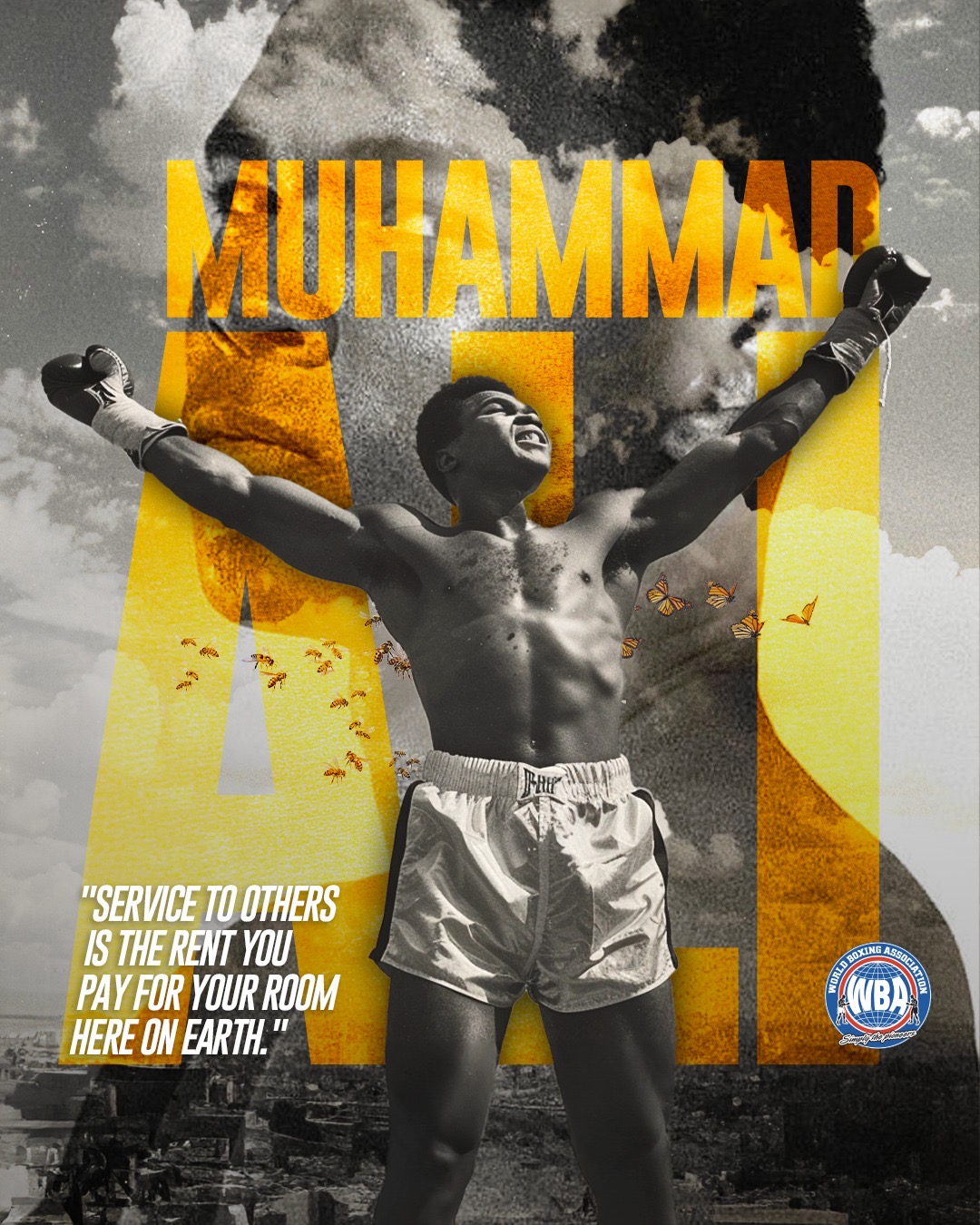
“Ali understood that to be great he needed a force beyond himself… If you fight only for yourself, it’s you against everyone else, and while that can motivate you, it will never give you the strength Ali possessed. Muhammad fought for something bigger than himself. He fought for God; his mission was far greater…” — Sports Illustrated reporter
We used those words years ago, though we can no longer remember exactly when, on the anniversary of the passing of the most charismatic figure in boxing history—and arguably in all of sports: Muhammad Ali. Born Cassius Marcellus Clay in Louisville, Kentucky, on January 17, 1942, Ali passed away on June 3, 2016, at the age of 74 in a Scottsdale, Arizona hospital, reportedly due to complications related to Parkinson’s disease, a condition he battled courageously for 32 difficult years.
The illness was diagnosed in 1984 by physicians at New York Presbyterian Hospital after neurological examinations conducted under the supervision of renowned neurologist Stanley Fahn. Ali fought Parkinson’s with the same determination and resilience that defined his legendary ring career, finally lowering his guard for the last time at age 74. By then, he had already become what he remains today: an immortal sporting icon and a revered symbol in America’s struggle for civil rights and religious freedom.
Ali’s professional career began on October 29, 1960, when the 18-year-old Olympic gold medalist from the Rome Games defeated the little-remembered Tunney Hunsaker over six rounds in his hometown of Louisville. More than two decades later, he retired in 1981 at age 39 with a record of 56 victories (37 by knockout) and 5 defeats, only one of them coming inside the distance, against former sparring partner Larry Holmes.
Historically, Ali remains the only heavyweight champion to reclaim the world title on three separate occasions—in 1964, 1974, and 1978. To countless fans around the world, he is still regarded as the greatest boxer ever to lace up gloves and undoubtedly the fighter who generated more global attention than any other in the sport’s long history.
From his professional debut in 1960 to his retirement in 1981, Ali filled newspapers and television screens around the globe with unforgettable moments. Among them were the incident that sparked his love for boxing after his bicycle was stolen at age 12 in Louisville; his Olympic gold medal triumph in Rome; numerous amateur championships; and his stunning rise through the professional ranks.
In February 1964, he shocked the world by stopping the seemingly invincible Sonny Liston in seven rounds to become heavyweight champion of the world. He followed that victory by knocking Liston out again in the first round of their rematch.
Ali’s career transcended sports when he refused military induction in April 1967, declaring himself a conscientious objector and famously stating, “I ain’t got no quarrel with them Viet Cong. No Viet Cong ever called me a Negro.” The decision cost him his heavyweight titles and forced him out of boxing for three and a half years.
Before and after that exile, Ali defeated many of the era’s finest heavyweights, including Brian London, Oscar “Ringo” Bonavena, Zora Folley, Henry Chuvalo, Henry Cooper, Cleveland Williams, Archie Moore, Floyd Patterson, Ernie Terrell, and Ken Norton, among many others.
When he returned to the ring in the early 1970s, Ali resumed winning before suffering only the first of his five professional defeats on March 8, 1971, against Joe Frazier at Madison Square Garden. Their 15-round war, highlighted by Frazier’s dramatic knockdown in the final round, is still regarded by many as the true Fight of the Century.
Ali and Frazier would meet twice more, with Ali winning both contests. Their final encounter, the legendary “Thrilla in Manila” on October 1, 1975, remains one of the most brutal and unforgettable battles ever fought inside a boxing ring.
Following retirement, Ali devoted much of his life to humanitarian causes and social activism. One of his most memorable public appearances came during the opening ceremony of the 1996 Olympic Games in Atlanta, when a visibly weakened Ali, trembling from Parkinson’s disease, lit the Olympic cauldron before a worldwide television audience in an emotional moment that moved millions.
His post-boxing years brought countless honors, including induction into the International Boxing Hall of Fame in Canastota, New York; the Presidential Medal of Freedom; recognition as Sportsman of the Century by Sports Illustrated and the BBC; the World Boxing Council’s designation as King of Boxing; the Martin Luther King Award; and the World Boxing Association’s Distinguished Service Award.
Rumble in the Jungle
We close this tribute to Ali’s memory with a look back at what was arguably the most famous fight in boxing history: the legendary “Rumble in the Jungle”, held on October 30, 1974, in Kinshasa, Zaire (now the Democratic Republic of Congo).
Promoted by Don King, the event matched reigning heavyweight champion George Foreman, undefeated at 40-0 with 37 knockouts, against the former champion seeking to reclaim his crown.
Foreman entered as a 7-1 betting favorite, but the crowd overwhelmingly supported Ali. Throughout fight week and during the bout itself, chants of “Ali bomaye!” (“Ali, kill him!”) echoed throughout Kinshasa.
The fight took place in oppressive heat during the early morning hours to accommodate television audiences in the United States. Nearly 60,000 spectators packed the stadium, while millions more watched around the globe.
Ali unveiled one of boxing’s most brilliant tactical performances. Leaning against the ropes and absorbing Foreman’s relentless attack, he employed the now-famous “rope-a-dope” strategy. Foreman threw punch after punch, expending tremendous energy while Ali blocked, deflected, and absorbed much of the punishment.
For seven rounds, the younger and stronger champion hammered away. By the eighth, however, Foreman was visibly exhausted.
Then came the finish.
Moments before the bell, Ali unleashed a sharp combination, capped by a perfectly timed right hand that landed flush. Foreman collapsed heavily to the canvas. The stadium erupted.
The champion struggled to his feet, but referee Zachary Clayton completed the count at 2:58 of Round 8.
It was the triumph of intelligence over brute force and remains, for many, the most iconic fight ever contested. An estimated 300 million viewers worldwide watched Ali reclaim the heavyweight championship in one of the defining moments in sports history.
Ali was ahead on all three scorecards at the time of the stoppage. Clayton had him leading 68-66, while judges Nourridine Adalla and James Taylor scored the fight 70-67 and 69-66 in his favor.
He was the fighter who “floated like a butterfly and stung like a bee,” the self-proclaimed greatest and most beautiful boxer of them all—the man who challenged political power, fought for civil rights, embraced his faith, and inspired generations far beyond the ring.
Parkinson’s disease may have slowed his body, but it never diminished his legacy.
Ten years after his passing, Muhammad Ali remains forever present in the hearts of boxing fans around the world.
Rest in peace, Champion.