
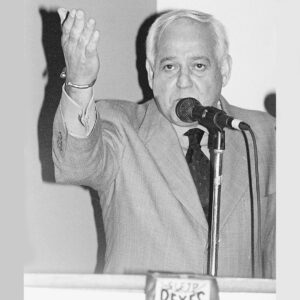
Today, Monday the 30th, marks the 83rd anniversary of the birth in Barquisimeto, Lara state, of Venezuelan engineer Francisco Gilberto Mendoza—simply Gilberto Mendoza to the boxing universe—a discipline to which he was devoted and which he led as helmsman for more than 33 years (from 1982 to 2015) from the World Boxing Association (WBA).
Now 105 years since its founding, the WBA remains the oldest governing body in the sport, originally established as the National Boxing Association in 1921 and known by its current name since 1962. Since 2016, it has been presided over by his son, Gilberto Jesús Mendoza.
The anniversary of Gilberto’s birth provides a fitting opportunity to remember the man who passed away ten years ago, whose legacy within the WBA is undeniable—a heritage that continues to serve as the guiding course of the “ship,” as Gilberto liked to call the organization he captained for more than three decades.
With that in mind, and as a simple tribute to someone who contributed so much to one of the oldest and most universally followed sports, we present excerpts from an interview conducted with Gilberto some 11–12 years ago. The interview offers a fairly complete insight into his vision of boxing.
⸻
GILBERTO GAVE EVERYTHING TO BOXING
Without further introduction, what follows is a brief overview of the professional and sporting career of Gilberto Mendoza, the ever-remembered WBA president, who gave everything to his passion for boxing:
Venezuelan engineer Gilberto Mendoza served for 32 years as the top authority of the World Boxing Association (WBA), the oldest of the organizations governing the sport worldwide.
At the time of this interview, he and his executive team were fully engaged in preparations for the WBA’s 92nd Annual Convention, held at the Los Delfines Hotel in Lima, Peru, from October 13 to 19, 2013.
In this interview, Mendoza analyzes a wide range of issues within the sport. The material had been “kept on ice” awaiting the right moment for publication. The interview is structured in ten questions, presented below:
⸻
1. When and where were you born, and who is Gilberto Mendoza?
I was born on March 30, 1943, in Barquisimeto, Lara state. I am an industrial engineer, a graduate of Universidad Católica Andrés Bello in Caracas (1966), with postgraduate studies in Administration and Organizational Development at the University of Toledo, Ohio, USA. I specialized in formal business planning processes at the Stanford Research Institute in Palo Alto, California.
Currently, I provide consulting services to companies in the Venezuelan sugar industry. I have served as president of the WBA since October 1982.
⸻
2. How did you get into boxing, and how did you rise to the top position in the WBA?
Fernando Mandry Galíndez (RIP) and Alberto Sarmiento played a major role in my beginnings as a boxing official in 1976. That same year, the Aragua Boxing Commission was formed, where I began as treasurer, while Alberto Sarmiento served as president.
I later joined the WBA Executive Committee as Chairman of Ratings (1978–79), where I developed the Ratings Manual—the first and only one in professional boxing. I was then appointed Administrative Advisor (1980–1982), during which I developed the WBA Organizational Structure, a Budget Manual, a Fight Supervision Manual, a project for judges and referees seminars, and a formal planning system for the WBA’s strategic direction.
Since October 7, 1982, I have served as president of the WBA.
⸻
3. What is your opinion on the proliferation of sanctioning bodies and the number of world champions, including interim champions?
It is a difficult question. Modern boxing depends heavily on economic power and television exposure. The proliferation stems largely from that first factor. Sponsorship and advertising revenue exceed what gate receipts can generate. This creates a significant commercial dynamic that affects governing bodies.
⸻
4. In the past there were only eight weight classes. Today there are seventeen. Isn’t that too many?
Boxing is a vehicle for social mobility for underprivileged youth through their fists. The new weight divisions provide better medical safety and greater competitive balance. Boxing has always been a spectator sport, but today it is also a form of entertainment. Fans adapt, although some still cling to the romantic concept of the sport.
⸻
5. Were economic interests or television pressure behind the creation of so many divisions?
Weight divisions have a scientific basis. A clear example is the gap between middleweight and light heavyweight—about 15 pounds, or roughly 7 kilos. That difference gives a significant advantage to the heavier fighter.
⸻
6. What has been your most satisfying moment as WBA president?
Rather than choosing just one, I would highlight several. One is having carried out, for over 20 consecutive years, the World Campaign Against Drugs, with a strong social and sporting vision. “Love Your Life, Promote Sports, Benefit the Nation” was its slogan.
This initiative gave rise to the annual KO Drugs tournaments, which greatly benefited boxing, especially the development of Latin American talent. It also helped launch the careers of many Venezuelan champions, beginning in 1984 with Bernardo Piñango’s title win in Atlantic City.
Another milestone was having five world champions in a single year (1988): Bernardo Piñango, Leo Gámez, Antonio Esparragoza, Fulgencio Obelmejías (all WBA), and José Sanabria (IBF).
I must also mention our role in helping eliminate racial discrimination in South African boxing—a complex process due to the economic impact on major promotions in that market. Still, there is peace of mind in having done the right thing, placing social justice above powerful interests.
⸻
7. What future do you see for boxing globally in times of economic crisis?
Boxing is the genuine form of struggle of the common individual. It offers an escape from many social issues. Like everything, it has its ups and downs. In the future, fans will demand more competitive fights. Punchers and brawlers who deliver excitement will have greater appeal. Technical boxers will need to take more risks.
⸻
8. Who is the most complete fighter you have seen?
I would choose “Sugar” Ray Robinson, Muhammad Ali, and Henry Armstrong.
⸻
9. Who is the greatest Venezuelan boxer of all time?
I would name three: Morocho Hernández, for being the first; Leo Gámez, for winning four titles in four different divisions—all WBA; and Antonio Esparragoza, for his integrity in the ring and personality outside of it.
⸻
10. What is your opinion on women’s boxing?
Women’s boxing is here to stay. Female fighters always give something extra, perhaps due to the prejudice they have had to overcome, achieving great success. The level continues to improve, and they deliver exciting fights. The quality is rising, and bouts are often highly competitive, which fans appreciate.
They have also helped expand new markets: Peru with Kina Malpartida, Costa Rica with Hanna Gabriels, Argentina with Yessica Bopp, Yessica Marcos, and Mónica Acosta, Norway with Cecilia Braekhus, and in our country, Ogleidis Suárez.