

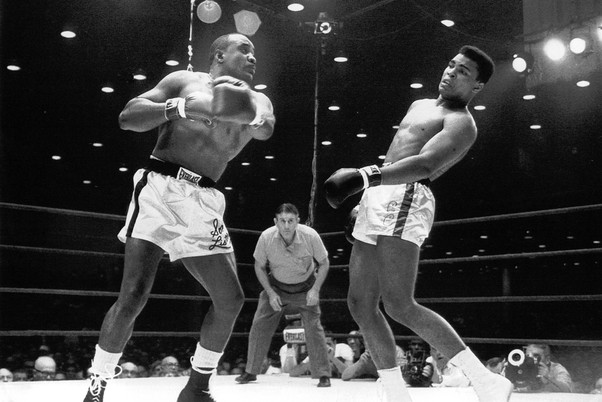
On this day — February 25, 2026 — it has been exactly 62 years since that unforgettable Tuesday night in 1964, when a little over 4,000 fans packed into the Miami Beach Convention Hall in Florida and witnessed one of the greatest shocks the sport has ever known.
The reigning heavyweight champion of the world, Sonny Liston, remained seated on his stool at the start of the seventh round, unable to continue due to a left shoulder injury. Across the ring, a brash 22-year-old challenger named Muhammad Ali — then still fighting as Cassius Marcellus Clay — was crowned the new heavyweight champion of the world, recognized by the World Boxing Association, the World Boxing Council, the New York State Athletic Commission, and The Ring magazine.
The stunning upset still stands as one of the biggest surprises in boxing history. Even the legendary former heavyweight king Joe Louis called it the greatest upset of all time.
Liston entered the bout at 216 pounds, standing 6-foot-1, and earned a purse of $1,360,000. Clay, 6-foot-2 and 210 pounds, took home $362,000 — both astronomical sums for that era.
Not long after the fight, Clay would announce to the world that he had discarded what he called his “slave name” and adopted Muhammad Ali, reflecting his conversion to Islam.
Going into the fight, Clay was a 6-to-1 underdog. Most experts and fans believed the intimidating Liston — listed anywhere between 32 and 34 years old, his true age uncertain — would demolish the young upstart in short order. Liston brought a 35-1 record with 24 knockouts and a fearsome reputation as one of the most destructive punchers in the division’s history.
The Louisville native, born January 17, 1942, came in undefeated at 19-0 with 15 knockouts. He had turned pro four years earlier, shortly after winning light heavyweight gold at the 1960 Summer Olympics in Rome.
The miscalculation was collective.
Liston had steamrolled nearly every opponent placed in front of him. The aura of fear was real. He had brutally dispatched former heavyweight champion Floyd Patterson twice in the first round. A former inmate at the Missouri State Penitentiary — where he learned to box — Liston carried a menacing persona, compounded by reported ties to organized crime.
⸻
THE FIGHT
Liston came out aggressively, looking to end matters early — his usual approach. Clay countered with his now-famous style: darting in and out, hands low, circling, firing combinations, “floating like a butterfly, stinging like a bee.”
The pattern held through the early rounds. Momentum shifted in spurts, but neither man established full control.
At the end of the fifth round, chaos erupted in Clay’s corner. The challenger complained he couldn’t see — that he was “blind.” Something from Liston’s gloves, he claimed, had burned his eyes. In distress, he asked his trainer, Angelo Dundee, to cut off his gloves. He didn’t want to continue.
But Dundee, the seasoned cornerman, refused.
“Get back out there. Stay away from him. Just run,” Dundee instructed.
Clay obeyed. As his vision cleared, he resumed firing sharp combinations — lefts and rights that began to mark up and punish the champion.
According to ringside accounts, when Liston returned to his corner after the sixth, he slumped onto his stool and muttered, “That’s it.”
His team believed he meant he would finish Clay in the next round.
They were wrong.
When the bell rang for the seventh, Liston — bleeding around both eyes and nursing his injured shoulder — angrily spat out his mouthpiece and asked for his gloves to be removed. He stayed seated.
Across the ring, Clay, Dundee, and their team erupted in celebration.
Ever the showman, Clay stormed toward press row shouting, “I am the greatest! I shook up the world! Where are your words now?”
When the official scorecards were later reviewed, they showed the fight was even at the time of the stoppage.
⸻
THE REMATCH — “THE PHANTOM PUNCH”
One year later, on May 25, 1965, they met again at the Central Maine Youth Center in Lewiston, Maine, before another modest crowd.
That night would enter boxing folklore as the “Phantom Punch” fight.
In the first round, Ali — now fully known to the world by his new name — landed a short right hand he later called the “anchor punch.” Many in attendance claimed they never saw it. But it sent Liston crashing to the canvas just over two minutes into the round.
The confused referee, former heavyweight champion Jersey Joe Walcott, initially hesitated. Only after The Ring editor NatFleischer informed him that more than 10 seconds had passed did Walcott wave it off and declare the knockout.
The second fight carries a backstory as complex — and perhaps even more controversial — than the first. But that, as they say, is a story for another day.